
Google AI Overviews for Contractors: 5 Steps to Adapt (2026)

A homeowner's furnace clicks at 9 p.m. She doesn't call three HVAC companies and compare quotes. She types "why is my furnace making a clicking noise" into Google. An AI Overview answers the question - and mentions two local HVAC companies she can call.

One of them might be you. For most contractors, it isn't.

In 2026, 45% of consumers use AI tools to find and evaluate local service businesses, up from just 6% one year ago (BrightLocal Local Consumer Review Survey, 1,002 US adults, February 2026). For HVAC, plumbing, roofing, and electrical contractors, that shift isn't coming - it's already here. And 98.8% of local businesses are invisible to it (SOCi Local Visibility Index, 350,000+ locations, 2026).

What changed? Which searches trigger AI Overviews? And what do you actually do about it? This guide answers all three.


Key Takeaways
- In 2026, 45% of consumers use AI for local business recommendations, up from 6% in 2024 (BrightLocal, Feb 2026)
- Organic CTR dropped 61% on AI Overview queries - but contractors cited inside an AI Overview get 35% more organic clicks than those ranking below it (Seer Interactive, Sep 2025)
- Informational queries like "why is my AC blowing warm air" trigger AI Overviews 92% of the time; "HVAC near me" queries trigger them just 15% of the time (Whitespark + Local Falcon, 2025)
- The five steps to earn citations: audit your presence, publish answer-first content, build review volume, complete your GBP, and make your entity consistent everywhere


Google AI Overviews for Contractors: What They Are and When They Appear

Google AI Overviews now reach approximately 2 billion monthly users and appear in roughly 40% of queries for local businesses in major service categories, according to Local Falcon's whitepaper analyzing 60,000 queries across 4,423 businesses (Local Falcon, May 2025). For informational queries - the "why," "how much," and "what should I expect" questions homeowners ask before calling a contractor - that rate climbs to 92%.

An AI Overview is the AI-generated answer box that appears at the top of Google search results, above organic links, ads, and the local 3-pack. Google pulls text, facts, and citations from multiple websites to construct its answer. If your business is cited, your name and sometimes your phone number appear before the homeowner clicks anything.

If you're not cited, you're competing for the smaller pool of attention below it.

Homeowners Using AI to Find Local ServicesSource: BrightLocal Local Consumer Review Survey (1,002 US adults, Feb 11, 2026)20246%202645%7x increase in 12 months - AI is now the #3 local discovery channel, behind Google and FacebookBrightLocal LCRS 2026
Source: BrightLocal Local Consumer Review Survey 2026 (Feb 11, 2026) - 1,002 US consumers

What makes AI Overviews different from a featured snippet is the type of question they serve. Featured snippets answer quick factual questions. AI Overviews answer complex, multi-part questions - exactly the kind homeowners ask before calling a contractor. "What's a fair price for a new HVAC system?" "How do I know if I need to repipe my house?" "What should I look for in a roofing contractor?"

Those are AI Overview questions. The businesses that answer them clearly get cited.
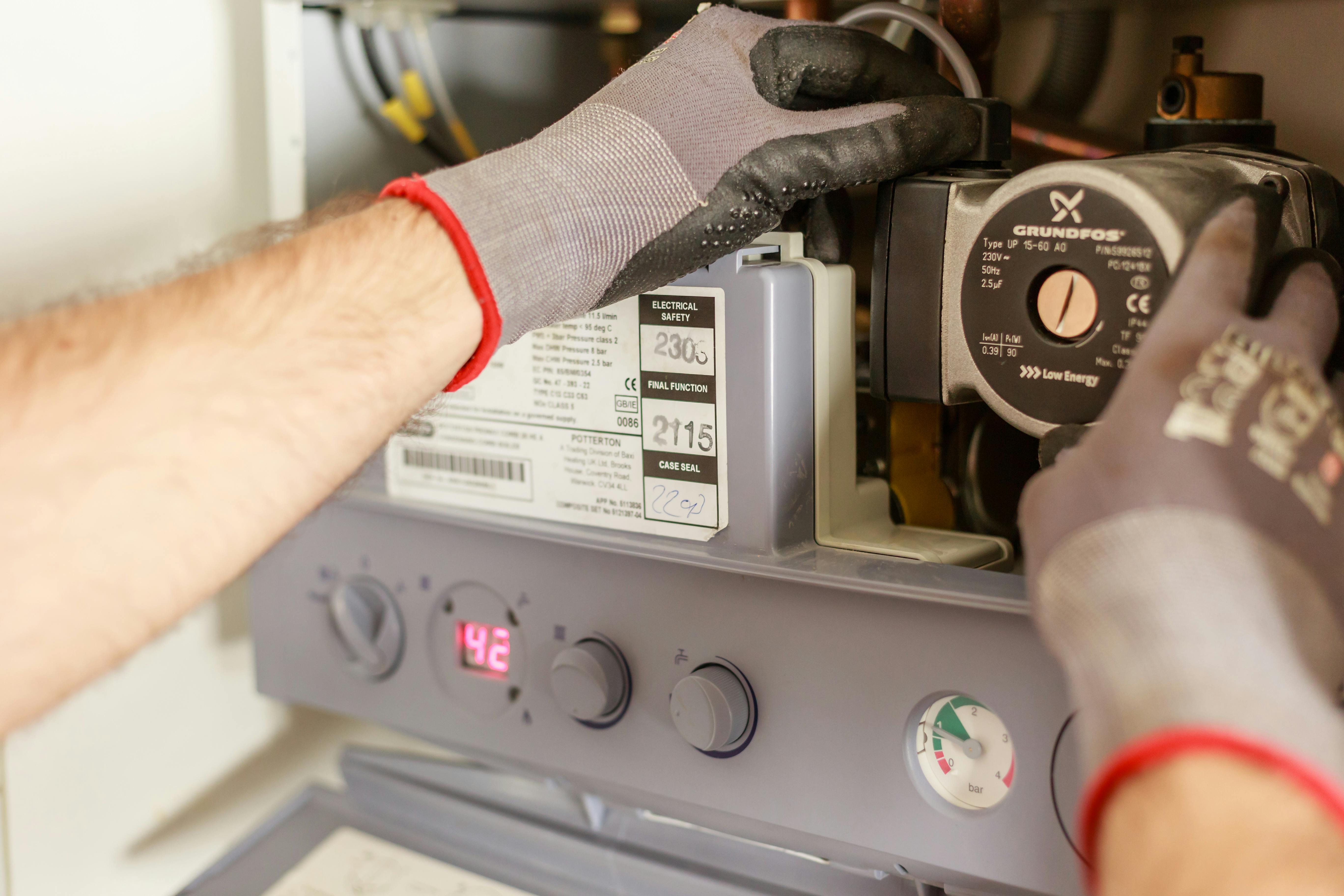
A technician's hands adjusting a boiler system with precision instrumentation, representing HVAC home service work

Tyrone's Take: In every contractor AI visibility audit I run, the same pattern appears. The businesses showing up in AI Overviews aren't the biggest companies in the market. They're the ones with specific, well-structured answers on their website and 80-plus Google reviews with consistent responses. Size doesn't determine AI citation. Content structure and trust signals do.

[INTERNAL-LINK: Full GEO strategy for home service trades -> "The Complete Guide to GEO for Home Service Contractors"]


How Are AI Overviews Affecting Click-Through Rates for Contractor Searches?

Organic click-through rates fell 61% overall on queries where AI Overviews appeared, dropping from 1.76% to 0.61% between June 2024 and September 2025, according to Seer Interactive's study of 3,119 search terms and 25.1 million organic impressions (Seer Interactive, Sep 2025). Ahrefs confirmed the same trend separately: position-one CTR dropped from 7.3% to 1.6% specifically on queries with an AI Overview present (Ahrefs, Feb 2026).

Here's what most reports on Google AI Overviews for contractors don't tell you: brands cited inside the AI Overview received 35% more organic clicks and 91% more paid clicks than brands ranking directly below it. AI Overviews don't kill traffic. They sort it - away from uncited businesses, toward cited ones.

Organic CTR: Position 1 Before vs. After AI OverviewsSource: Ahrefs (Feb 2026) + Seer Interactive (Sep 2025)0%2%4%6%8%7.3%Pre-AIOBaseline(Dec 2023)3.9%Rank #1,No AIO shown2.6%Rank #1,Cited in AIO1.6%Rank #1,NOT cited in AIO
Source: Ahrefs AI Overviews CTR Update (Feb 2026); Seer Interactive AIO Impact Study (Sep 2025)

What does this mean for your contracting business? If a homeowner searches "how much does an AC unit cost in Phoenix" and Google shows an AI Overview, ranking #1 without being cited is nearly as bad as ranking #10. The game isn't just about ranking anymore - it's about being selected.

Separately, 58.5% of all US Google searches now end with zero clicks to any website, and that rate jumps to 83% for queries with AI Overviews present (Semrush, 2025). But zero-click doesn't mean zero benefit: a homeowner who reads your AI Overview citation, sees your name, your location, and your specialty, then calls you directly - that's still a lead.

Seer Interactive's analysis of 25.1 million organic impressions found that brands cited inside Google AI Overviews receive 35% more organic clicks and 91% more paid clicks than uncited brands ranking directly below the AI Overview (Seer Interactive, September 2025). For local contractors, citation inside the AI Overview now outperforms ranking position one below it.

[INTERNAL-LINK: See how GEO and traditional SEO compare -> "GEO vs SEO: What's the Real Difference for Trade Businesses?"]


Which Contractor Search Queries Actually Trigger Google AI Overviews?

In 2025, informational and hybrid queries trigger AI Overviews over 90% of the time on local searches, while simple "near me" queries show AI Overviews just 15% of the time, according to Whitespark's case study of 540 queries across Houston, Phoenix, and Denver (Whitespark, May 2025). Local Falcon's larger analysis of 60,000 queries confirmed the pattern across 20 countries: "reason" queries triggered AI Overviews 59.9% of the time; simple local intent, 17.2%.

This is the most actionable data point in this entire article. Why? Because most contractors are optimizing for the wrong queries.

AI Overview Appearance Rate by Contractor Query TypeSource: Whitespark (540 queries, May 2025) + Local Falcon (60,000 queries, May 2025)Hybrid intent"Why isn't my furnace igniting - fix near me"97%Informational"How much does HVAC replacement cost?"92%Commercial + reason"Best plumber for slab leak detection"59.9%Commercial intent"HVAC contractor Atlanta"17.2%Simple local intent"HVAC near me"15%0% 100%
Source: Whitespark case study (540 queries, 3 US cities, May 2025); Local Falcon whitepaper (60,000 queries, May 2025)

In plain terms for trades contractors:

  • "HVAC near me" - the Google Local 3-Pack handles it. AI Overviews rarely appear.
  • "Why is my furnace not igniting?" - AI Overview appears 92-97% of the time.
  • "How much does drain cleaning cost in [city]?" - AI Overview appears over 90% of the time.

Your service pages alone don't earn AI Overview citations. The homeowner who searches "HVAC near me" is ready to call - they'll find you through the Local 3-Pack. But the homeowner asking "how long does it take to replace a water heater" is still in the research phase. That's the AI Overview audience. The contractor who answers that question clearly gets named when the homeowner picks up the phone.

A plumber working on exposed pipes inside a wall, performing residential plumbing repair

Whitespark's 2025 case study found that informational contractor queries - "how much," "why is," "what causes" - trigger Google AI Overviews 92% of the time. Simple "near me" searches trigger them just 15% of the time (Whitespark, May 2025). For HVAC, plumbing, roofing, and electrical contractors, informational blog posts and FAQ pages are the primary pathway to AI Overview inclusion - not service pages alone.


Before You Start: What This Process Requires

What you'll need:

  • A Google Business Profile (claimed and verified)
  • A website with at least a few service pages you can edit
  • Realistic expectations: consistent results take 90-180 days
  • Time commitment: 3-5 hours per month

The five steps below work for all four home service trades. They're ordered by impact, not ease.


Step 1: Audit Your Current AI Overview Presence

By the end of this step, you'll know exactly where you appear (and don't appear) across 10 high-value query types - and you'll have a monthly tracking system to measure progress.

Run these 10 searches in Google, using your actual service area:

  1. "Why is my [service issue] [your city]" - e.g., "why is my AC not cooling the house Atlanta"
  2. "How much does [your main service] cost in [city]"
  3. "How long does [your main service] take [city]"
  4. "What to expect when [your service type]"
  5. "Best [your trade] contractor [city]"
  6. "Signs I need a new [your product or system]"
  7. "How to choose a [your trade] contractor"
  8. "Emergency [your trade] [city]"
  9. "[Specific service] vs [alternative] for homeowners"
  10. "What questions to ask [your trade] contractor"

What to record: Does an AI Overview appear? Is your business cited? Which competitor appears if you don't?

Log results in a spreadsheet. Run this same 10-query audit on the first of every month.

What we find in Google AI Overviews for contractors audits: In over 90% of free AI visibility audits run for HVAC, plumbing, roofing, and electrical companies, the client appears in zero of these 10 test queries. The competitors who do appear share one trait: specific, factual content on their website that directly answers these questions.

A confident contractor in a hard hat and safety goggles at a construction site

[INTERNAL-LINK: Get a professional audit -> Green Owl Systems Free AI Visibility Audit (/services/free-audit/)]


Step 2: Build Answer-First Content Google Can Extract

By the end of this step, every service page on your website will contain the specific, factual information Google's AI needs to cite you - rather than moving on to a competitor who does.

The single most impactful change you can make is adding factual content that directly answers the questions homeowners ask before calling. AI Overviews pull from pages that answer questions clearly and specifically - not from pages that say "we're the best HVAC company in [city]."

Add these four elements to every service page:

  1. A cost section - "What Does [Service] Cost in [City]?" with actual price ranges, not "call for a quote"
  2. A process section - "What to Expect When You Call Us" in plain language, step by step
  3. A timeline section - "How Long Does [Service] Take?" with specific time ranges
  4. A FAQ section - 5-10 questions with direct, factual answers (AI Overviews frequently pull from these)

The answer-first rule: Every section should open with the direct answer in the first sentence. Not a hook. Not background context. The answer. AI systems extract the first sentence of each section - if it doesn't contain the answer, they move to the next result.

WEAK: "When it comes to HVAC replacement costs, there are many factors to consider..." STRONG: "A full HVAC system replacement in Atlanta costs $4,500 to $9,000 for most single-family homes, depending on unit size and existing ductwork condition."

The second version is what gets cited.

Google AI Overviews pull from pages that open each section with a direct, specific answer - including price ranges, timelines, and process steps. Pages that bury the answer after general context are skipped in favor of pages that lead with the answer (Local Falcon, May 2025).

[INTERNAL-LINK: Schema markup for trades -> "Schema Markup for HVAC, Plumbing, and Roofing Websites: A Practical Guide"]


Step 3: Build the Review Foundation AI Overviews Rely On

Review volume, rating, and recency are trust signals that Google's AI systems factor into citation decisions. In 2026, 63% of active AI users trust AI recommendations for local businesses (BrightLocal, Feb 2026). That trust is grounded partly in the review data AI systems can verify.

For contractors trying to earn AI Overview citations, these benchmarks matter:

  • Minimum volume: 50+ Google reviews before you see meaningful AI visibility improvement. Under 20 reviews, it's unlikely you'll appear.
  • Rating floor: 4.2+ stars. Below this, AI citation likelihood drops sharply.
  • Velocity over volume: 5-10 new reviews per month beats 200 old reviews with none in the past six months.
  • Response rate: Reply to every review within 48 hours. This signals active entity status to Google's AI systems.

The review ask is where most contractors leave the easiest wins. A simple text message sent within two hours of job completion - while the homeowner is still satisfied - converts at 3-5x the rate of an email sent a week later.

A tradesperson performing maintenance on plumbing fixtures inside a cabinet

BrightLocal's 2026 Local Consumer Review Survey found that 63% of consumers who actively use AI tools for local business recommendations trust those recommendations (BrightLocal, Feb 2026). For contractors, review volume and recency are not just reputation signals - they're AI citation signals that determine whether your business gets named or skipped.

[INTERNAL-LINK: Full review strategy -> "How Google Reviews Influence ChatGPT and Perplexity Recommendations"]


Step 4: Optimize Your Google Business Profile to AI Standards

Your GBP is where Google's AI systems first verify your business entity before citing you anywhere. An incomplete or stale GBP signals an unreliable source - and AI systems don't cite unreliable sources.

The eight GBP elements that affect AI citation:

  1. Business name - must match exactly across your website, invoices, and every directory
  2. Categories - primary should be specific ("HVAC Contractor," not just "Contractor")
  3. Services list - complete every service with the terminology homeowners actually search
  4. Business description - 750 characters, plain language, includes your city and primary services
  5. Hours - current and complete, including holiday hours
  6. Q&A section - seed it yourself with cost, process, and timeline questions AI Overviews answer
  7. Photos - minimum 20 business photos including team, trucks, work in progress, and completed jobs
  8. Weekly posts - one post per week signals freshness to Google's AI systems

Industrial rooftop with HVAC unit and service ladder against a clear sky

Sterling Sky's June 2026 State of Local SEO report found that AI-powered local packs appear in only about 7% of tracked local keywords - and when they do appear, they surface 68% fewer unique businesses than the traditional 3-pack (Sterling Sky, Jun 2026). A complete, active GBP is how you earn one of those fewer spots.

[INTERNAL-LINK: Full GBP guide -> "Google Business Profile Optimization for AI Citations: A Contractor's Checklist"]


Step 5: Make Your Business Entity Consistent Across Every Platform AI Checks

AI systems cross-reference multiple sources before citing a business. They compare your Google listing to your website, your Yelp profile, your BBB listing, and your industry directories. Inconsistencies - a different phone number, a slightly different business name, a missing address - signal unreliability.

Entity consistency checklist:

  • Business name: identical across Google, Yelp, BBB, Angi, HomeAdvisor, Houzz, and your website
  • Phone number: same digits everywhere (formatting matters less than consistency)
  • Address: consistent including suite numbers and abbreviations (St. vs Street)
  • Website URL: resolving correctly with no redirect errors on key pages
  • Service area: matches what you state on your GBP vs. your website
AI Local Pack vs. Traditional 3-Pack CoverageSource: Sterling Sky State of Local SEO 2026 (Joy Hawkins) - 322 US markets analyzed% of Local QueriesUnique Businesses Shown93%Traditional3-Pack7%AI LocalPack18,330Traditional3-Pack5,943AI LocalPackAI packs show 68% fewer unique businesses than traditional 3-packs
Source: Sterling Sky "State of Local SEO 2026" by Joy Hawkins (Jun 26, 2026)

The smaller pool of businesses in AI-powered local packs makes entity consistency more important than it's ever been. When Google's AI is choosing between two similar HVAC companies, inconsistent citations across directories is a reason to exclude a business - not include it.


3 Mistakes Contractors Make When Chasing AI Overview Citations

Most contractors who learn about AI Overviews and try to respond make the same three errors. Here's what to skip:

1. Targeting only "near me" queries The instinct is to optimize for "HVAC contractor near me" - but AI Overviews appear for those queries only 15% of the time. The 90%+ opportunity is in informational content: cost guides, troubleshooting explanations, process walkthroughs. That's where the work needs to go.

2. Publishing service pages without factual specifics A page that says "we provide quality HVAC services throughout Atlanta" gives AI nothing to cite. A page that says "HVAC tune-ups in Atlanta run $85-$150 for most residential systems, typically taking 60-90 minutes" gives AI exactly what it needs. The difference is specificity.

3. Updating once and stopping AI systems weight content freshness. A cost guide from 2024 with no updates loses ground to a competitor who publishes similar content monthly. Even a quarterly price update and a new paragraph on current conditions maintains freshness signals.

Tyrone's Take: There's a fourth mistake most guides don't mention. Contractors who add answer-first content to their service pages but skip the Google Business Profile Q&A section are leaving the easiest citation signal untouched. Google's AI systems read GBP Q&A entries directly. If your GBP says "We charge $120-$180 for drain cleaning in Memphis" and your website says the same thing, you've created two consistent, specific data points. That's exactly what AI needs to cite you with confidence.


What to Expect: Timeline and Signs It's Working

Realistic results from this process take 90-180 days of consistent execution. Not because the steps are slow - because AI systems take time to re-crawl, re-index, and recalibrate trust signals.

Signs it's working:

  • Your monthly test queries (from Step 1) start returning your business in AI Overviews
  • Direct brand searches for your company name increase in Google Search Console
  • Callers mention finding you through Google's answer about a specific topic
  • AI referral traffic begins appearing in Google Analytics (source containing "chatgpt," "perplexity," or similar)

Monthly tracking habit: Run your 10 test queries on the first of every month. Note who appears, what content they cite, and whether your position changed. This takes 20 minutes and tells you more than any rank tracker.


Frequently Asked Questions

Do Google AI Overviews appear for "near me" contractor searches?

Rarely. Whitespark's 2025 case study of 540 queries found that simple "near me" searches trigger AI Overviews just 15% of the time. The Google Local 3-Pack still handles most pure local intent queries. AI Overviews dominate informational queries - cost questions, troubleshooting questions, process questions - which is where blog content and FAQ pages come in.

How long does it take for a contractor to appear in Google AI Overviews?

Most contractors who execute steps 1-5 consistently see their first AI Overview citations within 90-180 days. The key variables are how quickly you publish factual content, how fast your review velocity grows, and how competitive your service area is. Contractors cited in AI Overviews see a 4.4x higher conversion rate from that traffic vs. standard search results (Scorpion/Semrush via Contractor Magazine, May 2026) - the wait is worth it.

Do Google reviews directly affect AI Overview inclusion?

Yes - indirectly. Google's AI systems use your GBP data, review volume, and rating as trust signals when deciding which businesses to cite. Businesses with 50+ reviews at 4.2+ stars appear in AI Overviews at higher rates than those with fewer or lower-rated reviews. Review velocity matters too: stale review profiles signal inactive businesses to AI systems.

Can a small HVAC company compete with national chains in AI Overviews?

Yes - and this is where AI Overviews differ meaningfully from paid search. Large national chains like ARS or One Hour don't automatically dominate AI Overviews; those are driven by specific content and trust signals, not ad spend. A local HVAC company that publishes detailed cost guides for its specific city can outperform a national brand in AI Overviews for that market.

[INTERNAL-LINK: Full citation strategy -> "The Contractor's AI Citation Checklist: 12 Signals That Get You Recommended"]

How is Google AI Overview different from ChatGPT or Perplexity recommendations?

Google AI Overviews appear within Google Search and rely primarily on indexed web content and your GBP signals. ChatGPT and Perplexity use different citation pools - there's only about 12% overlap between what each platform cites. Optimizing for Google AI Overviews (this guide) strengthens your Google Search presence. Getting into ChatGPT and Perplexity requires a parallel strategy focused on off-site brand mentions, third-party publications, and community presence.

[INTERNAL-LINK: The full AI citation strategy -> "The Complete Guide to GEO for Home Service Contractors"]


The Contractors Who Move Now Will Own This Space

In 2026, 22% of homeowners consult AI tools first when they need a contractor - before they open Google Maps or call anyone from Angi (Scorpion/Semrush via Contractor Magazine, May 2026). That number will be higher in 2027.

Optimizing for Google AI Overviews for contractors isn't technically complex. Audit your presence. Write specific, factual content. Build your reviews. Complete your GBP. Stay consistent across every platform. That's what earns AI Overview citations - not algorithm tricks or expensive software.

The contractors who optimize for Google AI Overviews for contractors now will occupy those citation spots for years while competitors are still figuring out that local search changed.

Want to know exactly where you stand? Green Owl Systems' free AI visibility audit shows you which queries trigger AI Overviews in your market, which competitors are already cited, and where you're invisible. Book your free audit.

[INTERNAL-LINK: Read next -> "The Complete Guide to GEO for Home Service Contractors"] [INTERNAL-LINK: Compare your options -> "GEO vs SEO: What's the Real Difference for Trade Businesses?"]

The Complete Guide to GEO for Home Service Contractors (2026)

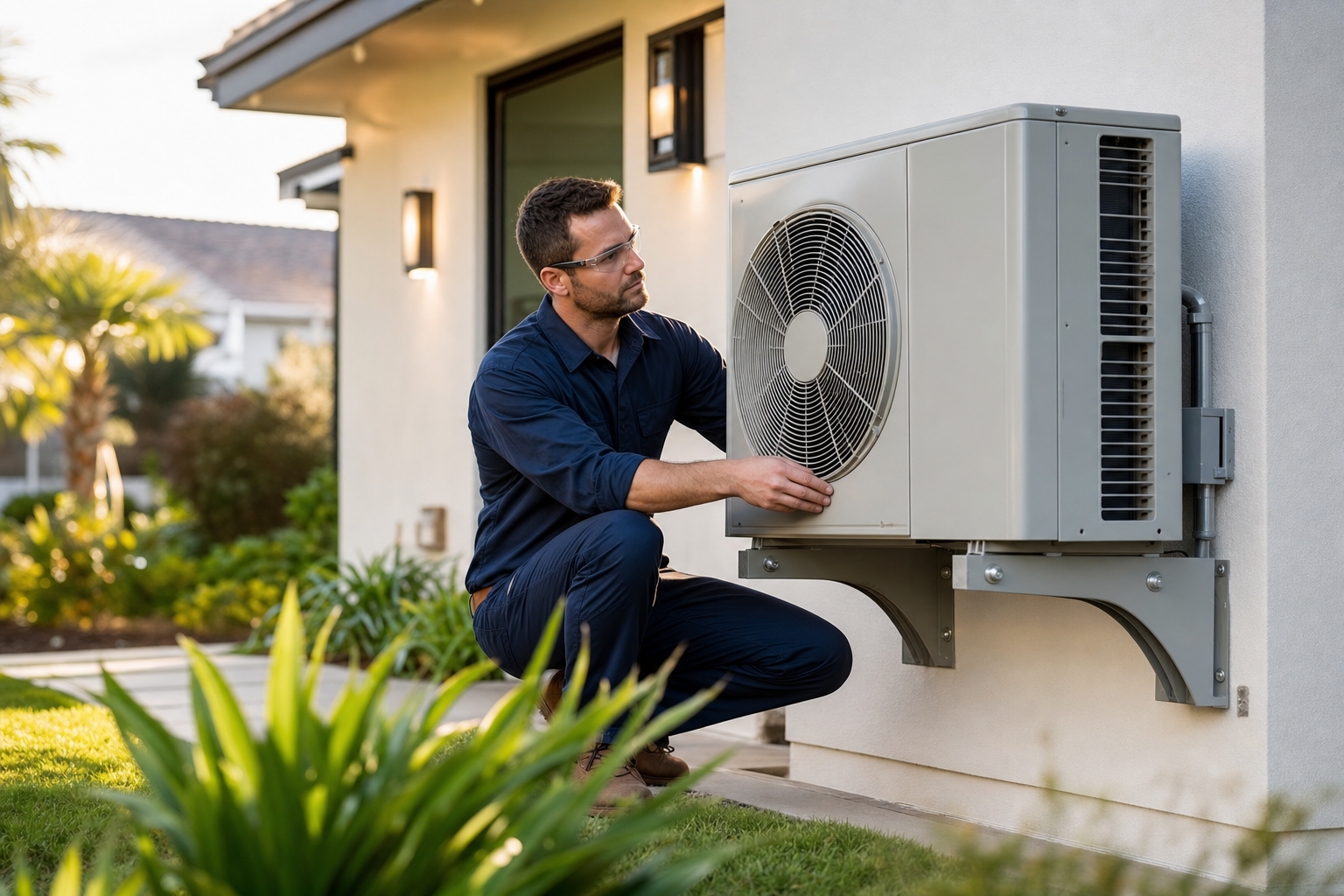
Professional HVAC technician inspecting AC unit outside a suburban home - GEO for home service contractors

A homeowner in Phoenix opens ChatGPT and types: "Who's the best HVAC company near me?" ChatGPT gives a name. It's not yours.

That's not a hypothetical. It's happening right now, in every market across the country, while most contractors are still focused on Google rankings and Angi lead costs.

According to the 5W PR AI Visibility Index 2026, 87% of HVAC and plumbing contractors are completely invisible in AI search. They don't appear when homeowners ask ChatGPT for a plumber recommendation. They're absent from Google AI Overviews when someone searches "best roofer in my city." They don't get cited by Perplexity when a homeowner is comparing electrical contractors.

That gap is called the AI citation gap. And closing it is what generative engine optimization (GEO) is for.

This guide breaks down everything you need to know: what GEO actually is, how it works differently for each trade, how long it takes, and exactly what to do in the first 90 days.


Key Takeaways

  • In 2026, 87% of HVAC and plumbing contractors are invisible in AI search (5W PR AI Visibility Index 2026)
  • 45% of consumers now use AI to find local services - up from just 6% one year ago (MarketingCode, May 2026)
  • AI-referred leads close at 73% vs. 31% for Google organic, based on Green Owl Systems client tracking
  • GEO takes 4-6 months to build - the contractors who start now will own the AI citation space before competitors realize it matters

What Is GEO (Generative Engine Optimization)?

In 2026, 45% of consumers use AI assistants to find local services - up from just 6% twelve months ago, according to MarketingCode's May 2026 consumer behavior report. GEO is the practice of making your contracting business the source those AI systems cite when homeowners ask for a recommendation. Unlike SEO, which earns you a ranked position in a list of blue links, GEO earns you a mention by name inside an AI-generated answer.

Think about the difference from a homeowner's perspective. With traditional search, they see ten links and choose one. With AI search, they read: "For HVAC repair in [city], [Company Name] has strong reviews and specializes in residential systems." One recommendation. Yours - or a competitor's.

What does a GEO citation actually look like? When a homeowner asks ChatGPT "who's a good plumber in [city]," the AI pulls from indexed web content, review platforms, directories, and third-party mentions to build its answer. It cites businesses that have clear entity signals (a consistent, well-defined online presence), strong third-party validation (reviews, directory listings, press mentions), and structured content that AI systems can extract and verify.

That's it. Not the biggest ad budget. Not the highest Google ranking - though that helps. The business with the clearest, best-documented digital identity wins the AI recommendation.

GEO matters for every home service trade. HVAC, plumbing, roofing, electrical - homeowners don't just use AI for research anymore. They use it to make decisions. The contractor who gets recommended first gets the call.

Homeowner holding smartphone searching for a local contractor using AI assistant

For a direct comparison of how GEO differs from traditional SEO, see our GEO vs. SEO breakdown for contractors.

Citation capsule: In 2026, 45% of consumers use AI assistants to find local services, up from 6% just twelve months earlier (MarketingCode, May 2026). GEO - generative engine optimization - is the practice of making your contracting business the cited source in those AI-generated answers, earning a recommendation by name rather than a ranked link in a search result list.


Why AI Search Is Changing How Homeowners Find Contractors

This isn't a future shift. It's happening right now.

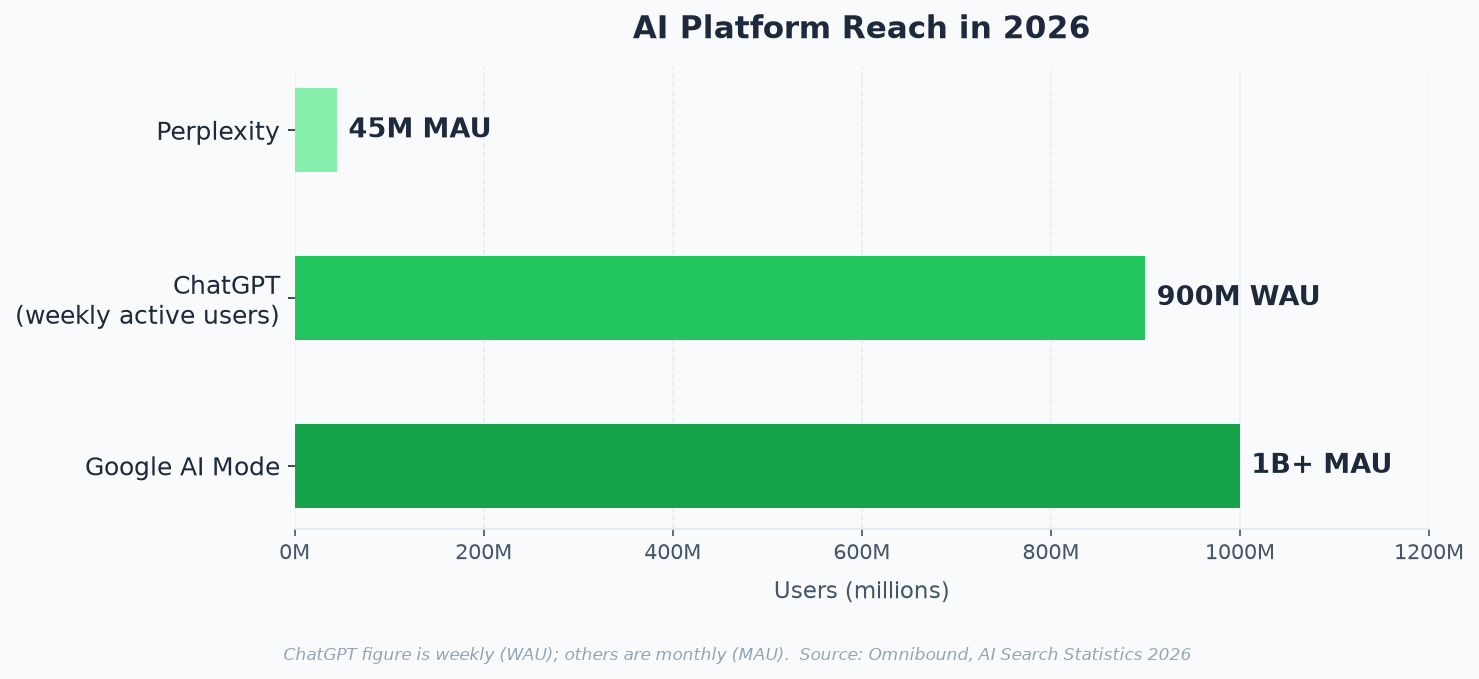
In February 2026, ChatGPT reported 900 million weekly active users, according to Omnibound's AI Search Statistics report. Google AI Overviews now appear in 25.11% of all Google searches - up from 13.14% in March 2025. Gartner projects a 25% drop in traditional search volume due to AI chatbots and virtual agents by 2026. That's not a marginal trend. That's a structural change in how people find local businesses.

For home service contractors specifically, this shift is already visible in the numbers. One in three homeowners under 45 used AI to find a home service provider in the last 90 days (MarketingCode, May 2026). Think about your customer base. How many of your recent calls came from someone under 45? Those homeowners are asking AI first.

Here's what makes this complicated for contractors: the three major AI platforms don't share citation sources. ChatGPT, Google AI Overviews, and Perplexity each pull from distinct citation pools, with only 12% overlap between platforms (MarketingCode, May 2026). A contractor who appears in Google AI Overviews might be completely absent from ChatGPT - even if they rank well organically. You're not optimizing for one search engine. You're optimizing for three separate recommendation systems.

What's happening to traditional search in the meantime? Ahrefs documented a position-one CTR drop from 7.3% to 2.6% when AI Overviews are present in the search result. The click doesn't happen because the homeowner already got their answer from AI. Either your business was the answer - or it wasn't.

Horizontal bar chart: AI platform reach in 2026 - Google AI Mode 1B+ MAU, ChatGPT 900M WAU, Perplexity 45M MAU
AI platform reach in 2026. All three platforms represent distinct citation pools with only 12% overlap (MarketingCode, 2026). Source: Omnibound AI Search Statistics 2026.

See how GEO compares with other contractor marketing channels on our Compare page.

Citation capsule: As of February 2026, ChatGPT has 900 million weekly active users, Google AI Overviews appear in 25% of all searches, and Gartner projects a 25% drop in traditional search volume due to AI assistants (Omnibound AI Search Statistics 2026; Gartner 2026). Home service contractors face a structural shift: a growing share of homeowners now find local businesses through AI recommendations rather than traditional search clicks.


GEO vs. SEO: What's the Real Difference for Contractors?

Here's a question I hear constantly: "Is GEO just SEO with a new name?"

It's not - and understanding why matters before you invest in either.

SEO earns you a ranked link in a list. GEO earns you a recommendation by name inside an AI answer. Both involve building a credible online presence, but they optimize for different outputs, different signals, and different platforms.

The most striking data point comes from Omnibound's 2026 AI Search Statistics report: 59.6% of all AI citations come from pages that are not in the top 20 organic search results. Let that land for a second. A contractor with a page ranking 22nd on Google could get cited in ChatGPT before a competitor ranking 3rd - because the lower-ranking page has clearer entity signals, better content structure, or stronger third-party validation. Traditional SEO tactics don't automatically transfer to AI citation.

That doesn't mean SEO is irrelevant. It means the two disciplines have different mechanics. SEO wins you clicks on a results page. GEO wins you mentions in AI answers. For contractors who depend on local discovery, you need both - but you can't optimize for one and assume you're covered for the other.

So what does the overlap look like? Strong schema markup, consistent NAP data, high-quality third-party mentions, and well-structured content all help both SEO and GEO. The difference is emphasis. GEO places much higher weight on third-party citation footprint (review platforms, directories, earned media) and content extractability - whether AI can pull a clear, quotable answer from your page.

A contractor who ranks first for "HVAC repair [city]" but has no structured FAQ content, inconsistent business information across directories, and zero third-party mentions will rank well in traditional search and be invisible in AI search. That gap is exactly what GEO closes.

See our full GEO vs. SEO breakdown for contractors, and learn how our 3-step GEO process bridges both.

Citation capsule: According to Omnibound's 2026 AI Search Statistics report, 59.6% of AI citations come from pages outside the top 20 organic search results. This means contractors can earn AI recommendations without high Google rankings - and contractors with high Google rankings can still be invisible in AI search. SEO and GEO optimize for different outputs and require distinct strategies.


The Four Factors That Determine Whether AI Recommends Your Business

Why does AI recommend one contractor over another? It's not random, and it's not primarily about ad spend. AI recommendations for local businesses come down to four factors. Understand these and you can build toward AI citation systematically.

1. Entity Authority - Does AI Know Who You Are?

Entity authority is how clearly and consistently AI systems can identify your business as a real, trustworthy local operation. This means consistent NAP data - name, address, phone number - across every directory and platform. A business listed as "Smith's HVAC" in some places and "Smith HVAC & Cooling" in others creates entity ambiguity. AI systems favor businesses they can confidently identify.

Google Business Profile completeness matters here. A GBP with complete service categories, photos, business hours, and service area definitions gives AI systems structured data to work with. Pair that with schema.org Organization markup on your website and you've built a machine-readable identity card for your business.

2. Citation Footprint - Who Else Is Talking About You?

In 2026, 85% of brand mentions in AI answers come from third-party sources - not from the business's own website, according to Omnibound's AI Search Statistics 2026 report. Your own website is responsible for only 15% of how AI learns about your business. The other 85% comes from review platforms, directories, local news, industry associations, and any other place that mentions you by name.

For contractors, this means Google reviews matter enormously - not just for local SEO, but for AI visibility. So do profiles on HomeAdvisor, Houzz, Thumbtack, Angi, and the BBB. Even a mention in a local news story or a contractor association newsletter contributes to your citation footprint.

3. Content Structure - Can AI Extract a Clear Answer From Your Site?

AI systems need to pull a clear, confident answer from your website. Pages with sequential heading structures and schema markup have a 2.8x higher AI citation rate than pages without them (Omnibound, 2026). That means answer-first content formatting, FAQ sections, and clear definitions of what you do and where you serve.

A service page that opens with "We've been serving the Phoenix area since 1998" gives AI nothing to cite. A service page that opens with "Smith's HVAC provides emergency AC repair across Phoenix, Scottsdale, and Tempe, with same-day service available and 500+ five-star Google reviews" gives AI a quotable, specific, verifiable claim.

4. Freshness - When Did You Last Update Your Presence?

AI systems weight recency. Pages that haven't been updated in more than three months are 3x more likely to lose AI citations than recently updated pages (Omnibound, 2026). For contractors, this means regularly publishing fresh content (blog posts, service updates, seasonal tips), responding to recent reviews, and keeping your GBP current with posts and photos.

Contractor business owner reviewing online presence and reviews on a laptop at their office desk

Our GEO and AI visibility service addresses all four factors as part of the same structured process.

Citation capsule: AI recommendations for local contractors depend on four signals: entity authority (consistent business identity across the web), citation footprint (85% of AI brand mentions come from third-party sources per Omnibound 2026), content structure (2.8x citation advantage for structured pages per Omnibound 2026), and freshness (pages not updated in 3+ months are 3x more likely to lose citations). Miss any one of these and AI systems will consistently pass you over.


How GEO Works for Each Trade (HVAC, Plumbing, Roofing, Electrical)

Not all contractor niches behave the same way in AI search. Each trade has distinct query patterns, seasonal spikes, and homeowner intent that shape what AI systems pull from and how they respond. Here's how GEO plays out differently by trade.

HVAC

HVAC is the most AI-search-active home service trade. In 2026, HVAC businesses have the highest AI tool adoption rate among home service contractors at 81.5%, according to industry data. AI query volume for HVAC peaks sharply in July (AC repair) and January (heating) - mirroring traditional search seasonality - but AI answers are cached and refined over time, not just at peak periods.

The homeowner asking ChatGPT "who's a good HVAC company near me" in June is setting the expectation that shapes who they call in August. Building your AI citation presence now - in the off-season - means showing up in the answers before peak demand hits.

Common HVAC AI queries: "best HVAC company in [city]," "how much does AC repair cost," "who does emergency furnace repair near me." See our full GEO guide for HVAC contractors.

Plumbing

Plumbing sees the highest proportion of emergency-intent AI queries of any home service trade. "Emergency plumber near me," "pipe burst what to do," "who to call for water heater leak" - these happen at inconvenient hours from stressed homeowners who need a fast answer. AI systems responding to emergency plumbing queries tend to pull from businesses with strong review velocity and clear service area definitions.

The GEO opportunity for plumbers is in emergency intent content: pages that answer the exact questions panicked homeowners ask at midnight. See our GEO guide for plumbing contractors.

Roofing

Roofing's AI search spikes are weather-driven. After a major storm, ChatGPT and Perplexity query volume for local roofers surges. The contractors who built their AI citation presence in the months before storm season are the ones who get recommended during it.

There's also a trust element unique to roofing. Homeowners ask AI questions like "how do I know if a roofer is legitimate" and "what questions should I ask a roofing contractor." Roofing companies that publish educational content answering these questions get cited as authoritative sources. See our GEO guide for roofing contractors.

Electrical

Electrical is the fastest-evolving trade in AI search right now, driven by EV charger installation queries. "Who installs EV chargers near me," "cost of home EV charger installation," "licensed electrician for panel upgrade" - these are high-value queries where AI search is becoming the first stop. See our GEO guide for electrical contractors.

Licensed electrician in safety vest working on a residential electrical panel - home service trades GEO

Citation capsule: Each home service trade has distinct AI search patterns. HVAC query volume peaks in July and January, with HVAC businesses showing the highest AI adoption rate at 81.5% (industry data, 2026). Plumbing sees the highest emergency-intent AI queries. Roofing citation demand surges after storms. Electrical queries are growing fast, led by EV charger installation and panel upgrade searches. Trade-specific GEO content that matches these patterns earns significantly higher citation rates than generic contractor content.


How Long Does GEO Take? Realistic Timelines for Contractors

Here's the honest answer most GEO providers won't give you: even when executed correctly, GEO takes 4 to 6 months before you see consistent AI citations.

This isn't a switch you flip. It's a reputation you build.

Why does it take that long? AI systems need time to index and process your structured content, observe your third-party citation patterns across multiple data refreshes, build confidence in your entity through consistent signals over time, and weigh you against local competitors who already have citation footprints.

The typical GEO timeline for a home service contractor looks like this:

Here's something else worth understanding: the 12% overlap between platforms (MarketingCode, May 2026) means you're building three citation presences simultaneously, not one. A citation win on Perplexity doesn't automatically transfer to ChatGPT. The AI systems share some source data but have distinct citation pools. That's why the timeline is what it is - you're covering three surfaces, not one.

The contractors who start now are building a 4-6 month head start on every competitor who waits. That advantage compounds.

See our 3-step GEO process for a full timeline breakdown of what we do in each phase.

Citation capsule: Building consistent AI citation presence for a home service contractor takes 4-6 months even when executed correctly, based on Green Owl Systems client audit data (2026). This timeline reflects the time AI systems need to process content updates, accumulate third-party citation signals, and build entity confidence. The three major AI platforms - ChatGPT, Google AI Overviews, and Perplexity - share only 12% of citation sources (MarketingCode, May 2026), meaning each platform requires separate optimization.


What AI-Cited Contractors Are Doing Differently

I've run AI citation audits for contractors across dozens of markets. The businesses that show up consistently in ChatGPT, Google AI, and Perplexity aren't always the biggest companies. They're not always the highest-rated companies. What they share is a complete, consistent, extractable digital identity.

Here's what that looks like in practice.

When I search ChatGPT for "best HVAC company in [city]," a cited contractor typically has:

  • A Google Business Profile with 4.7+ stars, 150+ reviews, and a complete service area definition
  • NAP data that matches exactly across Google, their website, HomeAdvisor, and Yelp
  • A website with answer-first service pages that open with specific, verifiable claims: "We provide same-day AC repair across Phoenix, Scottsdale, and Mesa"
  • FAQ sections on service pages that answer the exact questions homeowners ask AI
  • Recent reviews mentioning specific services, locations, and outcomes - not just generic praise

The non-cited contractor - even with a higher Google ranking - usually has some version of these problems: an incomplete GBP, NAP mismatches across directories, service pages that read like brochures rather than answers, and a review profile that hasn't grown in months.

Why does this matter beyond just appearing in AI? The lead quality difference is significant.

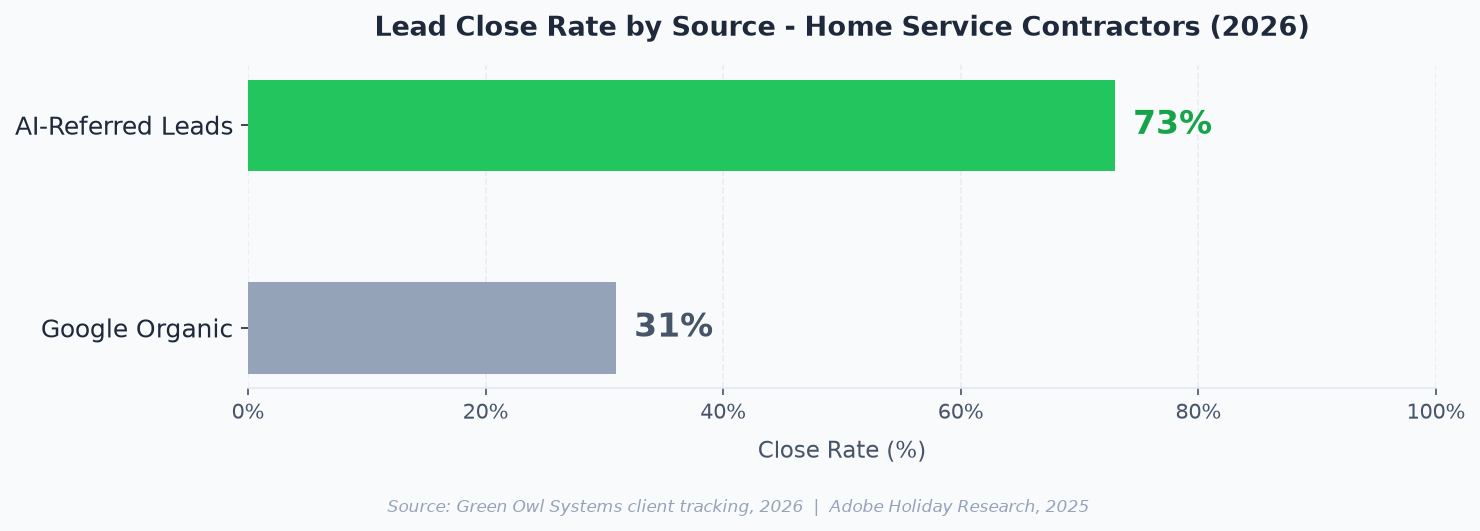
In 2026, AI-referred leads to home service contractors close at 73%, compared to 31% for Google organic leads - based on Green Owl Systems client tracking. The homeowner who found you through an AI recommendation has already received context about your business: your location, your specialties, your reviews. They're not comparison shopping. They're calling to book.

That's consistent with broader market data: Adobe's 2025 holiday retail research found AI referral traffic converts 31% higher than non-AI traffic and visitors spend 68% more time on-site than traffic from other channels.

Horizontal bar chart: lead close rate by source - AI-referred leads 73% vs Google organic 31% for home service contractors
AI-referred leads close at 73% vs 31% for Google organic. Source: Green Owl Systems client tracking, 2026.

Get a free AI visibility audit to see exactly where your business appears - and doesn't appear - in AI search right now.

Citation capsule: Home service contractors cited in AI search close leads at a 73% rate compared to 31% for Google organic leads, based on Green Owl Systems client tracking (2026). AI-referred homeowners arrive pre-informed about the contractor's services, location, and reviews, reducing the comparison-shopping step that suppresses conversion rates. Adobe's 2025 research confirms AI referral traffic converts 31% higher than non-AI traffic across industries.


How to Start Getting Recommended by AI: The First 90 Days

So where do you actually start? The first 90 days are about building the four-factor foundation. Here's the framework.

Step 1: Claim and Complete Your Entity Signals (Days 1-14)

Your digital identity needs to be consistent, complete, and machine-readable before AI systems can confidently recommend you.

Step 2: Structure Your Website Content for AI Extraction (Days 15-30)

AI systems can only cite what they can clearly read and extract.

Rewrite your service pages to open with a specific, verifiable claim about what you do and where you serve. Not "we've been in business since 1998." Something like: "Smith HVAC provides emergency AC repair and HVAC installation across Phoenix, Tempe, and Scottsdale. Same-day service available. 350+ five-star reviews."

Add a FAQ section to every service page. Use the exact questions homeowners ask AI - "How much does AC repair cost in Phoenix?" "How long does an HVAC installation take?" "Do you offer financing for new units?" This is the content AI pulls from most readily.

Structure headings hierarchically: H1 for page title, H2 for main sections, H3 for subsections. AI systems use heading structure to understand and extract page content.

Step 3: Build Your Third-Party Citation Footprint (Days 31-60)

Remember - 85% of AI brand mentions come from third-party sources. Your website alone isn't enough.

Ask every satisfied customer for a Google review. Set up an automated review request (text or email after job completion) with a direct link to your Google review page. Review recency matters as much as volume - 10 new reviews this month outperforms 100 reviews from 18 months ago.

Create or claim profiles on HomeAdvisor, Thumbtack, Houzz, Angi, Yelp, and BBB. Keep them updated with current photos and service descriptions.

Get mentioned in local news, neighborhood platforms like Nextdoor, or contractor association newsletters when possible. Even one local press mention significantly boosts your third-party citation footprint.

Step 4: Create Trade-Specific, Location-Specific Content (Days 61-90)

AI recommendation is driven by whether you have content that directly answers the questions homeowners ask for your specific trade and location.

Publish service + location pages: "AC Repair in Phoenix," "Furnace Installation in Scottsdale," "Emergency Plumber in Mesa." Each page should open with a direct answer to the most common AI query for that service and location combination.

Start a simple blog with monthly posts covering seasonal topics, common homeowner questions, and local context. Document your work with before/after photos and job outcome descriptions - this gives AI systems specific, verifiable content to cite.

Our full GEO service covers all four steps with done-for-you implementation. Questions about the approach? Tyrone Sims runs every audit and strategy session personally.

Citation capsule: The first 90 days of GEO for a home service contractor focus on four areas: completing entity signals (consistent NAP, Google Business Profile, schema markup), restructuring website content for AI extraction (answer-first service pages, FAQ sections), building a third-party citation footprint (reviews, directories, local press), and publishing trade-specific, location-specific content that answers the exact questions AI systems pull from. All four areas must be addressed - on-site optimization alone covers only 15% of what drives AI citation.


Frequently Asked Questions

Is GEO just SEO with a new name?

No. SEO earns you a ranked position in a list of search results. GEO earns you a mention by name inside an AI-generated answer. The tactics overlap - strong entity signals, quality content, and authoritative third-party sources help both - but the goals and platforms are distinct. In 2026, 59.6% of AI citations come from pages outside the top 20 organic results (Omnibound 2026), so you can't rank your way to AI citation. See the full GEO vs. SEO comparison for contractors.

Does GEO work for small contractors, or only large brands?

GEO actually favors well-defined local entities with strong review profiles - which is exactly what a 5-15 person contractor can build. AI systems don't recommend the largest company; they recommend the best-documented local answer. A roofing contractor with 80 consistent Google reviews, complete GBP data, and structured service pages will outperform a national franchise with poor entity clarity. See what GEO looks like for your specific trade.

How much does GEO cost for a home service contractor?

Pricing varies by market size and competition. Most contractors see meaningful GEO traction before they'd spend three months of typical Google Ads costs at current CPLs - which WordStream puts at $70.11 average for home services in 2025. The better question is ROI: if AI-referred leads close at 73% vs. 31% for paid leads, the math changes significantly. See our AI visibility service for current pricing.

Will GEO replace my Google Ads or existing SEO?

GEO complements both - it doesn't replace them. Think of AI citation as a third traffic channel that operates independently of paid search and organic rankings. Given the 12% overlap between AI platforms (MarketingCode 2026), you should optimize for all three surfaces - traditional organic, paid, and AI citation - rather than consolidating into one channel.

What's the first thing I should do to start GEO?

Get a baseline. Before investing in any optimization, find out where your business currently appears - and doesn't appear - across ChatGPT, Google AI, and Perplexity. Run the query yourself: ask ChatGPT "who's the best [trade] company in [your city]?" and see what comes back. If you want a formal audit with recommendations and a prioritized action plan, that's exactly what our free AI visibility audit covers.


The Window Is Open Right Now

AI search isn't coming for home service contractors. It's already here - and 87% of HVAC and plumbing businesses are invisible in it right now.

The shift is measurable and accelerating. In 12 months, consumer AI adoption for local services went from 6% to 45%. One in three homeowners under 45 used AI to find a home service provider in the last 90 days. Those numbers don't reverse.

Here's what this means for your business:

  • GEO and SEO are different disciplines. A high Google ranking doesn't mean AI recommends you. Optimize for both separately.
  • Four factors determine whether AI cites you: entity authority, citation footprint, content structure, and freshness. Each is buildable in 90 days.
  • The window is open right now. GEO takes 4-6 months, and the contractor in your market who starts this month gets cited before competitors who wait until next year.

The homeowner who uses ChatGPT to find an HVAC company next summer is going to get a name. Make sure it's yours.

Or learn more about our GEO and AI visibility service if you're ready to start building.


Sources

  1. 5W PR, AI Visibility Index 2026: Home Services Edition, 2026
  2. MarketingCode, Consumer AI Adoption for Local Services, May 2026
  3. Omnibound, AI Search Statistics: 55+ Data Points on GEO, Buyer Behavior, and Citation Rates, February 2026 - https://www.omnibound.ai/blog/ai-search-statistics
  4. Gartner, Gartner Predicts 25% Drop in Traditional Search Volume by 2026, 2026
  5. Ahrefs, AI Overviews CTR Impact: Position-One Data Update, 2025
  6. Adobe, Holiday Season AI Referral Traffic Report, Q4 2025
  7. WordStream, Home Services and Contractor PPC Benchmarks 2025, 2025
  8. Green Owl Systems, AI Citation Audit Data: Home Service Contractors, 2026 - internal client tracking